Showing posts with label entrepreneurship. Show all posts

Monday, 20 April 2020

Business Opportunities From COVID-19

With the COVID 19 pandemic now affecting the entire world, we need to be prepared for the upcoming changes that it will bring to those who don't get sick. This implies huge shifts in the way we work and how we make a living.  Unfortunately, with businesses being closed down, many people are going to be without pay or worse without jobs.

The good news is that there are other jobs that are going to be created in other industries and will most likely thrive throughout this crisis. Here are a few things to watch out for.

Remote work will finally become more widespread.
In order to reduce the spread of COVID-19, many companies around the world have either had to close their doors, or have made it mandatory for their employees to do their work from home.


Businesses will realize after a couple of months of this that they can trust their office-dwelling employees to be just as productive when working from home.  The existing technologies for video conferencing, IP telephony, IT security and cloud computing will allow employees to do that.  So it's very likely that most companies will end up wanting to save on real estate costs, commute times, and absenteeism by no longer limiting "work from home" to specific roles (sales, consultants, virtual assistants, web developers, IT support, podcasting, etc.).

What might be interesting here is that many more jobs will be created by large businesses who won't need to hire locally because the job can be done using the right technology.

The rise of Virtual Training / Learning
This kinda relates to the point above about remote work, but with the same technologies being used for leisure. With gyms, yoga and dance studios, martial arts schools and other activities with big groups of people being shut down temporarily, it won't be long before virtual classes rise in popularity. Sure some people can follow YouTube videos for instruction, but having an instructor who can see you and correct what you're doing in real time without the risk of catching a virus is the next best thing.

The same goes for other education. With schools and universities closed down, lectures and homework are now being made available online. Again, with the technologies now available, expect to see more and more flexible, web-based, academic programs.


While these virtual classes might not replace the real person training when these locations are finally allowed to re-open, they will make for great supplementary material and additional income streams later on.

Delivery services will become more streamlined
The risks of spreading viruses by going into crowded spaces to shop will create new jobs in delivery services. Whether it's groceries, restaurant food, toilet paper, soap, alcohol, cannabis, or any other necessity, the fact that most people will need to stay home will create an even greater demand for delivery services. Yes, companies like Amazon, Uber, FedEx, UPS and of course the post office already have massive networks to deliver to your door.


However, with demand rapidly increasing, other companies will invest and innovate to further improve these delivery methods making it much easier for customers to get something sent to their door. With summer coming, we should also expect more and more local niche entrepreneurs offering delivery services that can promise faster delivery times than the logistical behemoths.

Streaming Services and Podcasts
Entertainment is going to be incredibly important with people staying indoors. Whether it's bored kids or adults needing escapist entertainment from the doom and gloom news stories, we're going to need something to distract us.

Getting easy access to Internet-based entertainment is going to be crucial.  We've already seen huge jumps in subscription numbers for Netflix, Amazon Prime video and Disney plus.  YouTube had to reduce their video quality to save bandwidth, expecting a higher volume of streaming.

So if you're a vlogger, a podcaster, a YouTuber or any kind of web content creator, the opportunities to build an audience and eventually monetize is bigger than ever.

--------------------------------------------------------------------

I am very thankful for being one of the lucky ones who has the ability to work from home. Yes the current pandemic has caused the loss of plenty of jobs. Instability and uncertainty seem to be the norm.  Despite all the economic doom and gloom news, there are going to be new opportunities for small businesses and entrepreneurs to pivot.  It's going to be possible for many of us to thrive during a crisis and come out of it stronger than before.

Wednesday, 26 February 2020

Develop credibility, humility, and a love of learning using a simple phrase

In the modern economy, expertise, skills and knowledge are some of the best measures of your competence. Many of us are afraid to admit whenever there's something we don't know. Despite that, one of the most important skills we need in the age of information is the ability to say "I don't know" both to ourselves and to others.


First, being able to admit that you don't know something forces you to stay humble. Being honest with yourself and others by saying "I don't know" means that you don't overstate your area(s) of expertise. This prevents you from receiving false recognition, which prevents arrogance and over-inflation of the ego.

Being able to say "I don't know" also keeps you curious and ready to learn. I'm not sure how most people are, but personally, if I'm asked a question and I don't know the answer, it bothers me. I want to find out the answer and look it up. That kind of behaviour develops curiosity and a love for learning new things. All because I admitted to myself and whoever is asking me a question that I don't know the answer.

Most importantly, in the long term, saying "I don't know" will keep you from losing credibility. There's always pressure to be a "subject matter expert", as well as the pressure to provide immediate answers without knowing what you're talking about. What will likely happen in this situation is that you'll give inaccurate information.  The person who receives that inaccurate information will make decisions, act on that information, and suffer the consequences.  When they do, you'll be blamed for their failure and be thought of as unreliable or worse, a liar.

Yes, it's important to be knowledgeable and skilled.  It's important to be able to answer questions about your field of expertise.  This is what competence in any field looks like. However, no matter how competent you are, there will always be something that you won't know. And that's all right. We're now in a world where almost all of human knowledge can be accessed almost instantaneously using a device in your pocket. You're better off saying "I don't know. I'll give you an answer as soon as I find out."

Wednesday, 12 February 2020

Feeling Insecure? Use the 8 Mile Method

A lot of problems, conflict, resentment and aggressive behaviour usually come from our own insecurities. We're all insecure about something because we're all flawed in one way or another as human beings.

Many of us feel afraid and insecure because we're afraid that at some point, those flaws of ours will be exposed and used against us. Some will use them to make us feel bad about ourselves. Others who are more Machiavellian will use those flaws and insecurities to manipulate us to their advantage.

So how do we avoid our insecurities getting the best of us? Use the "8 Mile" method.


In the movie 8 Mile, Eminem's character had to go through several rap battles where freestyle rappers try to get the best of their opponents by insulting them to a beat, as creatively as possible.  *Spoiler alert*:  At the end of the movie Eminem's character, at the final rap battle, decides to point out all of his own flaws in public. Basically, he dissed himself before his opponent could do it.  By doing that he took away any ammunition that his opponent could use against him.

The first step is to take an honest look at ourselves in both the literal and proverbial mirrors. That honest look will allow us to identify our flaws. This not only gives us the choice of doing something to get rid of those flaws and improve ourselves. It also allows us to accept the fact that we have said flaws and take ownership of them.

Once we accept that we have our flaws and we start owning them, (or better yet, we start working on eliminating those flaws), these insecurities will slowly start disappearing.

Wednesday, 29 January 2020

The Myth of "Easy"


We've all probably heard our friends, colleagues and family members say things that are similar to the following:

"It's easier to skip the gym and not exercise."

"It's easier to spend and not to save money."

"It's too difficult to stay disciplined when it comes to eating healthy."

"It's easier to goof off instead of going to school and to learning a skill."

"It's difficult to get up and go to work. I'd rather sleep in and call in sick."

"It's easier to use an app to get McDonald's delivered to my door than to go grocery shopping and cooking myself a healthy meal."

"It's easier to plop on the couch next to my significant other and watch Netflix instead of taking the time to sit down and have a conversation."

In the short term, sure the examples above may seem like the "easier" options. I would make the argument that if you look at the long term, going for the "difficult" options are actually what will make your life easier in the future.

Here are a few examples:

What's easier? Regularly exercising to strengthen your body or being so weak in your old age that you're living in constant fear of falling down and not being able to get up?

What's easier? Eating a serving of vegetables at each meal, or having to go a doctor because you're so constipated that you've only pooped once in the last 3 days?

What's easier? Getting up and going to school and/or work every day or being homeless at 60 years old?

What's easier? Delaying that major purchase to put money away for your retirement or being in your 70s and not having enough money to buy both food AND medication?

What's easier?  Making the effort to have small, meaningful, daily conversations with your significant other or going through divorce proceedings?

What's easier?  Going to school and getting an education or being unable to pay your bills because you can't get a job due to your lack of credentials and training?

Sure, some of these examples are maybe a bit extreme or "strawman-ish" but you get the idea. A lot of what we're doing (or not doing) in the short term might feel like the "easier" thing to do, but if you take a long term look, what we're actually doing is choosing to make our life harder in the long term.  So the next time you hear your inner voice telling you to take the easy path, just ask yourself, if it really is easier in the long run.

Wednesday, 8 January 2020

Excellence Means You Can't Live a "Balanced Life"

In a previous post, I outlined the simple, 2-step formula to become good at anything:
1) Practice a lot
2) Put in a lot of conscious effort to what you're practicing

Here's a revised version of the formula, if you want to become THE BEST at anything:
1) Practice exponentially more than before
2) Practice with conscious effort and nearly singular focus
3) Be lucky


Assuming you have the luck required, you will also need to drastically increase the amount of practice you do.  Because of the increased amount of practice required, you'll have to sacrifice time for other things: social life, sleep, time with family, leisure activities, etc.  You are focused almost entirely on whatever it is you're trying to be the best at.

This is true no matter what profession or field you want to become the best at.  Whether you want to become the most renowned neurosurgeon, the funniest stand-up comedian, an Olympic gold medalist, the most successful CEO, an elite professional hockey player, the most published and cited academic, or a world-champion MMA fighter, you will have terrible "work-life balance".  You'll need to sacrifice a lot of time not only to reach the pinnacle of your field but also to stay at the elite level.

This goes beyond the level of a hobby. You can't clock out at 5pm. Having the goal of being the best at something for a certain amount of time will come at the expense of other things in your life. If the concept of "work-life balance" is important to you, you will never become part of the elite in your field.  The truth is, at one point or another, we all wanted to be excellent something.  Becoming excellent requires an unbalanced lifestyle. For most of us, living that way for a long time is unsustainable.

Wednesday, 4 December 2019

Become Good at Saying No

If you've ever taken an Intro to Economics class, you would have probably heard of the concept of "Opportunity Cost". Briefly, the opportunity cost of making a choice are the missed benefits of choosing one alternative over another.

Because everyone has limited time, energy and resources, that means that when you agree to do something, you will miss out on other things. By saying "Yes" to do one thing, you're indirectly saying "No" to doing other things.

This is why one of the most important (and difficult) skills everyone needs to develop is how to say "No". Whether it's a business opportunity or friends and family members asking you to do them favours, you will receive requests that will require you to give up a combination of your time, energy and resources.


When thinking about saying "Yes" to any of these requests out of guilt, an unhealthy need to please others or perhaps a miscalculation of financial gain, remember what you're potentially giving up. Just ask yourself how much whatever you're being asked to commit to is going to cost in terms of your sanity, time away from loved ones, your physical health and/or your financial well-being. Then you'll realize why "No" can be one of the most valuable words in your vocabulary.

Wednesday, 27 November 2019

Never be Afraid to Quit


We've all heard the adage: "Winners never quit.  Quitters never win."

Nothing could be further from the truth.

The better adage is: "You gotta know when to hold 'em. Know when to fold 'em. Know when to walk away. And know when to run."

Yes, persistence and perseverance can get you far.  You can become very successful by sticking to something for a long time while trying to improve.  It's a skill that can help you in life.

However, knowing when and how to quit something is actually equally important.  At some point, we have to recognize when we're no longer able to improve on a situation despite the amount of resources you've sunk into it.

We all need to recognize the point when, despite any additional effort, failure is inevitable. When that happens, learn from your failure, quit, then divert your remaining resources and energy on other endeavours (or a modified version of the failed one). This is how quitting will lead to future success.

Wednesday, 6 November 2019

Time is Money? Nope

"Time is money."  It's an old, false adage that many people in business just perpetuated.  The truth is that if you spend money, you can still make it back later on by trading your time.  When it comes to time, there's no amount of money that will allow you to get back time that you lost.  It's gone. If you're fortunate enough you'll be able to pay someone to do things you don't want so you can have more time for the things you want to do.
 
Learning how to spend our hard-earned money is incredibly important. Learning how to spend your time is even more so.  Most of us need to be smarter when choosing which activities to engage in when offered money in exchange for your time.  On the flip side, it's just as crucial to respect other peoples' time by providing them value when they've made a decision to give any amount of it to you.

Friday, 12 July 2019

Go Take an Actual Vacation

Vacation mode: ON !!!
A recent article from QZ was discussing how our one or two-week vacations are way too short for people to decompress and relieve the stress from work-related burnout.  Some are even suggesting that you should just take longer breaks for every two hours of work during your day to be less stressed out.

Sure we can't be all like the Europeans who work for companies that allow 4 to 6 week vacations.

Instead, how about we, as North Americans, change the way that we treat vacations?  One of the worst things that I see are email "out-of-office" replies saying that the person is on vacation but that they will "monitor their emails and cell phones in case there's an urgent matter".

No wonder people are feeling stressed out.

Instead of keeping yourself electronically tethered to your desk, why not disconnect from work and spend time with your family and friends? What's the point of spending money on a flight, on hotels, museums and on booze on the beach if you're not even going to try to temporarily escape the pressures of your job?

Maybe you legitimately like your job and you don't really want to go on vacation.  Maybe you feel like you're pressured by your employer and the company's culture to stay connected almost 24/7.  Maybe the company's culture has no respect for work/life balance. Maybe you're a control freak who thinks that if you leave, people backing you up won't be competent enough to cover you for a couple of weeks.  Or worse, maybe you're scared that your colleagues won't notice that you're gone because you secretly think that your job is not really that valuable to the company in the first place.  Maybe you're just a really nice person who doesn't want to leave their colleagues hanging out to dry if something goes wrong while you're away.


Sadly many of us see taking vacations as a source of stress. Many people feel stressed before they leave because they do double duty to complete things in advance before they leave.  They also feel stressed immediately after coming back because of the work that's piled up while they were away.

This is why you have people backing you up. In all likelihood, unless your employer sucks at hiring, there should be enough competent and intelligent people who can help pick up the slack while you're away. Trust these colleagues of yours because they'll be trusting you to do the same for them when they go away for vacation.

And for high-achievers who really think that vacations can be detrimental to their businesses, just remember, you can't perform at your optimum level if you're not rested.  Vacations are meant to recharge your batteries so you can push even harder to succeed.  Unless your job has life-or-death consequences, you really shouldn't be allowing anyone to interrupt your vacation.

So enjoy the beach, the lake, the woods, the new city that you're visiting, the taste of the new foods you'll try and/or the historic monuments that you'll see.  You're allowed to leave work for a while and actually enjoy your life.

Wednesday, 3 July 2019

We Are NOT Created Equal

This is a follow up on the previous piece on how to get good at anything.

The premise of practicing with full conscious effort will definitely get you as far as you potentially can in any given field. However, there are limitations to how far each individual can get because we are not born with the same genetic potential and predispositions.

Some people have the genetic predisposition to have more fast-twitch muscle. Some are more likely to have certain types of addictions. Other individuals are more likely to get certain kinds of cancer. Some will be born with missing limbs. Some have genes that cause them to have osteoporosis and arthritis before the age of 40. Others will be predisposed to have higher muscular endurance and a higher pain threshold. Some people will be born to be potentially 7 feet tall while others won't grow taller than 4 feet.

I could quit my day job, train for 8 hours a day and try to get faster at sprinting for the next 4 years. Despite the 10,000 hours of dedicated training I will never even come close to catching a retired, "out-of-shape" Usain Bolt in a 100 meter dash. Although I might be able to outdo him in other things (here's hoping any way).

 
Bottom line: constant practice with conscious effort will make you better at any skill. However, there is an upper limit that we can get to for each field, be it sports, intellectual pursuits, martial arts, music, or entrepreneurship.

Guess what! Life isn't fair. Every individual will have certain biological advantages over other people in certain fields while having disadvantages in others. Despite what any idealist with their heart in the right place will tell you, we are not all created equal. What's important is that we give everyone the equal opportunity to find, acquire and develop the skills that best fit with their strengths.

Friday, 28 June 2019

How to Get Good at Anything

It's a very simple formula.  Simple, but not easy.


To gain skills, be it playing a musical instrument, sports, stand-up comedy, acting, martial arts, math, languages, computer programming, public speaking, video editing, or even entrepreneurship, there is a very simple formula if you want to get better at any skill:

1) Practice a lot
2) Put in a lot of conscious effort to what you're practicing

The first point, you've heard before.  The "magic number" of 10,000 hours has been thrown around as the minimum needed to master a skill.  While it's been argued that this magic number is more or less legit, the point is, to get somewhat good at a skill, you need to have a lot of repetitions.  Without the practice, you won't get better.

What's more important though is the second point. You can "practice" something for 16 hours a day. If you are not consciously making the effort to practice whatever you're doing without trying to do it correctly, you're wasting your time. By practicing something without effort or without thinking for long periods of time, you'll just end up making yourself worse at that skill and develop bad habits. Instead, you need to go through the correct progressions, acknowledge that you made mistakes during practice and learn how to avoid them in the future.

Really you're just trying to find ways to be better than you were since the last time you practiced.


That's it.  No special shortcuts, no simple hacks.  Just put in time and conscious effort.

Wednesday, 8 May 2019

If Your Boss is an A**hole, Then We're All to Blame (Indirectly)

The same can also be said about your a**hole co-workers


It's almost stereotypical.  Some of you have even seen it in person: the executive or even a middle manager of an organization losing their temper.  There have been CEOs yelling, bullying, berating and being overall jerks to their employees.

A former, now deceased, CEO of one of the largest tech companies in the world (company name rhymes with "grapple") was notoriously aggressive at publicly berating employees who didn't "live up to his standards of quality".

You've also got managers who expect you to be constantly connected on weekends and holidays. They end up shaming you if front of your peers if you decide that you'd rather spend time with your family instead of answering the email they sent at 11:45pm.

Another famous CEO who runs the largest online store in the world (no, it's not Amazon) is making it a requirement for his employees to work from 9am to 9pm, 6 days a week. Anything less will get you shamed and fired, despite how well you perform while working less hours.

Yes, it's abusive behaviour.  Yes it creates a hostile work environment and a bullying company culture. It causes stress and burn out.

Guess what: we are all to blame for these terrible work environments. Here's why.

Admiration for "Getting Sh*t Done"


One of the problems is that humans as a society seem to have evolved to want to follow the alpha monkey as our leader. 


We end up admiring the conqueror (unless you're the one being conquered), the assertive/aggressive boss who won't let "useless processes" become roadblocks to their goals.  We like the person who isn't necessarily worried about hurting feelings or being a bully to "get the job done".  We see their seemingly demanding traits and interpret that as a leader having a high standard that we should all strive for.  

At the same time, we are captivated by a confident, charismatic public speaker who will be falsely self-deprecating to make themselves seem relatable and authentic. They make mild jokes in an attempt to get their employees to see how likeable they are when they're not being bullies.

To us, these characteristics are signs of the strong leader.   Incidentally, these are also some of the main characteristics found in clinical narcissists and sociopaths.  In any case, these are the kinds of traits that we like to see in our leaders.  

Because we, as a collective society and culture like those traits, people like that end up getting hired in those positions of power in the companies we work for.

The"Hustle Culture" Fetish


If you spend enough time following "entrepreneur", "motivational" and "influencer" accounts on social media, you'll see that a lot of them are posting about hustling and "rising and grinding".  It's not unusual to see these highly successful people showing videos and pictures of themselves getting up at 4:30am so that they can start lifting heavy kettlebells and running hill sprints.

Sure, there's nothing wrong with having goals and working hard to reach them.  I'm all for people wanting to work as hard as they want, as many hours as they need to feel great about themselves and to make their business successful.

The problem is that the constant stream of these social media posts has led to the creation of "hustle porn".  Hard work has become so fetishistic on social media that we as a society have come to admire the business leaders who get up early, work so hard late into the night on a daily basis to the point of burn out while wearing stress as a badge of honor.

The narcissist/sociopath business leader then sees this as an example to emulate, you know, because the Instagram post is getting so many likes.  And of course, if they're doing that, then they expect all of their employees to be "hustlers" as well.  It becomes inexcusable for employees to be unreachable on evenings and weekends because they want to spend time with their kids. In their minds, there's no excuse for being sick in bed not working because you can have a laptop or a smartphone with you on your bedside table.
Doing less is just being a lazy employee.

Overly Coddling Customers


In the end, all of these bullying behaviors stem from every businesses' fear of losing clients to the competition. As consumers, we've been spoiled to want every thing yesterday. If the toilet paper ordered online doesn't come within 24 hours, negative reviews get written and complaints are sent to customer service.

We as a society are all customers with these "immediate gratification" expectations at the lowest possible price from the businesses we patronize. Is it really a wonder that businesses then need to transfer that kind of pressure on business managers who in turn put pressure on their employees to deliver?  

In short, our attitudes as demanding, spoiled consumers who won't do anything inconvenient are partially to blame for our abusive bosses.  Instead of immediately writing a bad review or complaining to a manager because you received your double-shot grande caramel macchiato with soy milk 37 seconds longer than you expected, we need to take a step back and have a bit of perspective on how easy it is for us now to get whatever product product we want in the first place.


Wednesday, 1 May 2019

"Follow your Passion" is Terrible Career Advice


We’ve all heard the career advice during our younger, more idealistic days:
Find something that you’re passionate about and you’ll never work a day in your life.
The sentiment is great. The advice will make you feel good in the short run until of course you try to implement it.

Finding your actual passion requires actual work

If you actually look at the origin of the word “passion”, it comes from the Latin word for “suffer”. That’s actually a very different meaning from our modern-day association to a blissful existence.

The modern-day premise of following your passion almost implies that you will immediately love what you’re doing. In addition, if something truly is your passion, then it should come to you easily. 
The reality is that it takes a lot of time and effort to become “passionate” about something. More importantly, becoming passionate at something is highly connected to how good you are at something. That takes a lot of work.

Because we’ve been led to believe that our passion should come relatively easily, as soon as things get difficult in our pursuit, we’re more likely to give up. With a mindset like that, it might actually make it impossible to find your “true passion”.

Turning your passion into work will ruin your passion

One of the most well-meaning, but misguided advice about passion is:
If you’re not passionate about what you’re doing at work, you’re wasting your life.
The implication is that you should leave your “soul-sucking”, albeit steady job to pursue the true thing that you’re passionate about. It’s a romantic idea.

Who hasn’t dreamed of leaving their job, take whatever they’re passionate about, and try to turn it into their single source of income? After all, if you don’t have enough “skin in the game” by going all in, you won’t succeed in the pursuit of your passion. Right?

The problem is that you’ve now turned your passion into a job. With your passion project being your sole source of income, there is now a lot of pressure for it not to fail. Because there’s now stress involved, it’s no longer being done for fun. It’s become something that now keeps you up at night.

Following your passion most likely won’t be profitable… at least not immediately


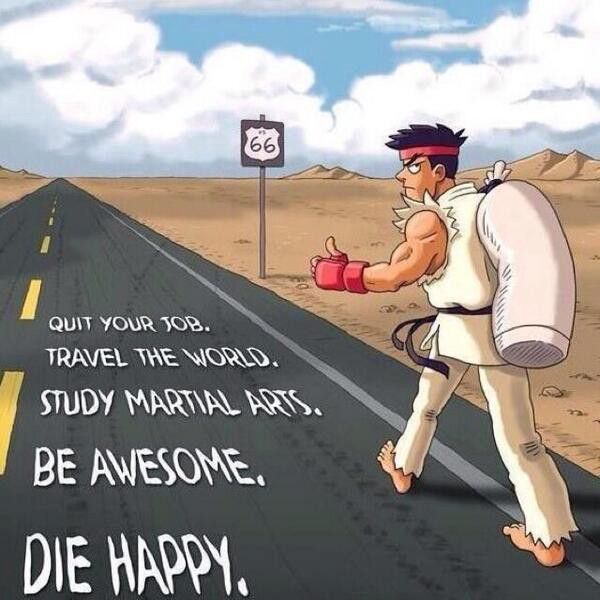
On a personal level, I’m passionate about visiting new places, learning martial arts and even teaching it. However, just because I’m passionate about traveling, practicing and teaching martial arts, doesn’t mean that I can make a living off of it. At least not immediately.

It can be doable, but again, it will take lots of time and effort for this activity to produce a livable wage. Quitting my day job right now to be a full-time, “professional, traveling martial artist” might not be the best idea just yet. It will take time to develop the skills needed to be successful enough to monetize. In the meantime, I still have bills to pay, groceries to buy, and a wife and (hopefully future kids) to support. Dropping everything to follow my passion would probably be a bit irresponsible.

Develop your passion instead

So does all this mean that pursuing a passion is a futile endeavor? Should we just give up and take the job that requires us to live the rest of our lives in a cubicle listening to eight different bosses drone on about mission statements? Not exactly.

The problem lies in the fact that the advice given to us when we’re young implies that you must be passionate about your job. That your job is what will give your life the fulfillment and sense of accomplishment that you need while at the same time allowing you to buy groceries and pay your rent and heating bill. Why should that be? Why can’t your job just be a method to make enough money to pay for the bare necessities, while outside of working hours, you are developing what you’re really passionate about?

Why not separate the two?

The day job can certainly give you that sense of accomplishment, but it can mainly function as the method for acquiring the resources you need to both pay your bills and develop your real passion.
By passion development, I’m talking about finding a hobby or activity that you can become better at over time by hours of practice. It would be the pursuit of mastery of this activity that will help bring you that sense of accomplishment that you might not necessarily get from your job.

Side-hustling: Monetizing your passions

Of course, if you do manage to find a way to monetize your passion, more power to you. What I would suggest though, boring as it may be, is to start small. I wouldn’t recommend leaving your day job just yet. Again, leaving a day job with a steady paycheck in favor of following a passion project will not only put financial stress on yourself and your family, but will essentially kill whatever love you have for that project.

The smart play to begin monetizing that passion is by creating a side-hustle. This prevents you from throwing yourself head first into something that may or may not fail. Because you’re forced to do this at a smaller scale you won’t feel the constant pressure to grow the business that you would have if you were doing this full time. Instead, it gives you the time to actually develop the passion and get better at what you’re doing. This allows you to play around with your ideas, test strategies and see what works with minimal impact if you fail. All while marginally adding extra income.

So is there still a way for me to follow my passion?

For most of us, that day may never come, but if you're lucky, it is possible to get to a point where you’re free to follow your passion and do it full time as a business. There are two criteria:

First, you’re now making enough money off it that you no longer have a need for the revenue from your day job. Second, more and more of your time is required and your day job is actually getting in the way of the project’s growth.

If and only if you are able those two criteria, then you can make the gradual shift from the day-job employee to the passion-project entrepreneur